
Most people don’t fail at goal setting because they lack ambition. They fail because the goals they set can’t survive contact with a busy Tuesday. You write down “get in shape” or “grow my business” in January, feel a rush of motivation for two weeks, and then watch it quietly evaporate by February. This isn’t a willpower problem. It’s a design problem.
Motivation isn’t something you either have or don’t have — it’s something you build into the structure of your goals. This article breaks down exactly how to set goals that keep you moving forward, even on the days you don’t feel like it.
Why Most Goals Fail to Keep You Motivated
Before fixing the problem, it helps to understand why typical goal-setting falls apart. Three patterns show up again and again:
The goal is too vague. “Be healthier” or “make more money” gives your brain nothing concrete to act on.
The goal is outcome-only. You focus entirely on the destination and ignore the daily process that gets you there.
The goal depends on motivation showing up on schedule. Real motivation is inconsistent, so goals built entirely on “feeling like it” collapse the first time you don’t.
Once you see these patterns, the fix becomes clear: build goals that don’t rely on willpower alone, and create systems that generate motivation instead of waiting for it.
Start With a Reason That Actually Matters to You
Every goal needs a “why” strong enough to survive a bad day. Weak reasons (“I should probably exercise”) get abandoned fast. Strong reasons are personal, specific, and emotionally real.
Instead of “I want to save money,” try “I want to save money so I can leave a job that’s draining me.” Instead of “I want to write more,” try “I want to finish this book because I’ve started and stopped it three times and I’m done letting fear win.”
A useful exercise: write your goal, then ask “why does this matter?” five times in a row, each time going deeper than the last. By the fifth answer, you usually hit the real motivator — and that’s the one worth writing on a sticky note.
Set Goals That Are Specific and Measurable
Vague goals produce vague effort. Specific goals give your brain a clear target and a way to track progress, which is one of the biggest drivers of sustained motivation.
Compare these two goals:
“Get better at my job” vs. “Complete one certification course by the end of the quarter and apply one new skill to a real project each month.”
“Read more” vs. “Read 20 pages a day, five days a week.”
The second version in each pair is trackable. You know exactly what success looks like today, this week, and this month — and that clarity keeps you moving when enthusiasm fades.
Break Big Goals Into Small, Winnable Steps
Big goals are motivating in theory and paralyzing in practice. “Launch a business” or “run a marathon” can feel so large that it’s hard to know where to even begin, so people freeze or procrastinate.
The fix is breaking the goal into steps small enough that starting feels almost too easy:
1. Take the big goal and list every major milestone required to reach it.
2. Break each milestone into weekly actions.
3. Break each weekly action into a daily task that takes 30 minutes or less.
This approach works because motivation follows momentum, not the other way around. Small wins generate the confidence and energy needed to tackle the next step, creating a self-reinforcing cycle instead of relying on a single burst of inspiration to carry you through months of work.
Focus on Systems, Not Just Outcomes
Outcome goals (“lose 20 pounds,” “hit six figures”) tell you where you’re going but nothing about how to get there day to day.
Systems — the repeatable habits and processes behind the outcome — are what actually keep you motivated, because they give you something to do today, not just something to hope for eventually.
James Clear’s well-known distinction between goals and systems captures this well: goals are about the results you want, and systems are about the process that produces those results. If you focus only on the outcome, you’re motivated only when you’re winning. If you focus on the system, you can feel successful every day you follow it, regardless of where the scoreboard sits.
Practical application: instead of “lose 20 pounds,” build the system of “walk 30 minutes daily and cook dinner at home four nights a week.” The system is something you can succeed at today, which builds the motivation to keep going tomorrow.
Track Progress Visibly
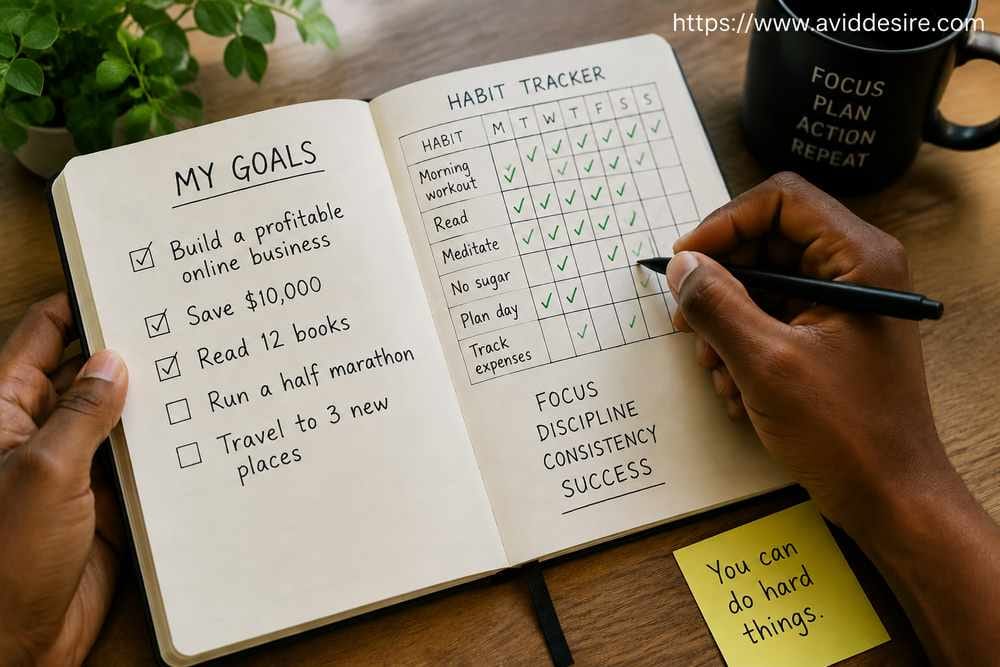
Progress is one of the most powerful motivators there is, but only if you can see it. Untracked progress is invisible progress, and invisible progress feels like no progress at all — which quietly kills motivation even when you’re actually moving forward.
Simple tracking methods that work:
A habit tracker with a checkmark for each day completed
A visible chain of X’s on a calendar (the “don’t break the chain” method)
A weekly review where you write down three wins, however small
A spreadsheet tracking numbers relevant to your goal (savings, weight, words written, sales made)
The format matters less than the visibility. When you can look back and see two weeks of consistent effort, that visual proof becomes its own motivation engine.
Build in Accountability
Motivation is easier to sustain when someone else is watching, even a little. Accountability doesn’t have to mean a formal coach or a strict system — it just needs to create a small cost for skipping and a small reward for showing up.
Options that work well:
Share your goal with one person and give them a specific way to check in (“text me every Friday”)
Join a group working toward a similar goal
Post your progress publicly, even to a small audience
Use a habit-tracking app that shows streaks and sends reminders
The specific method matters less than the principle: external accountability catches you on the days internal motivation doesn’t show up.
Plan for the Days You Don’t Feel Motivated
Every goal-setting plan needs a strategy for low-motivation days, because they will happen. The goals that survive aren’t the ones protected from bad days — they’re the ones with a plan for them.
Two techniques help here:
The two-minute rule: on days you have zero motivation, commit to just two minutes of the task. Often starting is the hardest part, and two minutes turns into twenty.
Minimum viable effort: define the smallest version of the habit that still counts (“one push-up,” “one paragraph,” “five minutes of practice”). This keeps the streak alive without requiring full effort every single day.
Both techniques share the same insight: consistency matters more than intensity. A goal you show up for imperfectly every day beats a goal you attack perfectly for a week and then abandon.
Revisit and Adjust Your Goals Regularly
Goals set once in January and never looked at again lose their power fast. Motivation stays high when a goal feels current and relevant, not like a stale resolution from months ago.
Build in a regular check-in — weekly or monthly — where you ask:
Is this goal still the right one, or has priority shifted?
What’s working, and what isn’t?
Does the plan need to be adjusted based on what I’ve learned so far?
This isn’t about lowering the bar every time things get hard. It’s about keeping the goal alive and realistic, so it stays something you actually want to pursue rather than an obligation you’re avoiding.
Celebrate Milestones Along the Way
Waiting until the very end of a long goal to feel good about it is a motivation killer. Long goals need celebration points built in along the way, so the process feels rewarding, not just the finish line.
Set specific milestones and plan how you’ll acknowledge them — not necessarily with a big reward, but with genuine recognition that you’ve made real progress. A halfway point, a first client, a completed first draft, a new personal best — each of these deserves a moment of acknowledgment before you move on to the next stretch.
Final Thoughts
Goals that keep you motivated aren’t the result of trying harder or wanting it more. They’re the result of better design: a real reason behind the goal, specific and measurable targets, small steps, systems over pure outcomes, visible tracking, accountability, and a plan for the inevitable low-motivation days.
Start with one goal you’ve been circling for a while. Rewrite it using the principles above — sharpen the reason, break it into small steps, and set up one way to track it. You’ll likely notice the difference within the first week: not because you suddenly have more willpower, but because the goal itself is finally built to last.
About The Author
